







Installing a solar power system is one of the smartest long-term investments for Indian homeowners, businesses, and industries. With rising electricity costs and increasing awareness about clean energy, more people are exploring solar finance options to make the transition easier and more affordable.
But one important question often comes up before installing a solar system:
Should you choose a Solar Loan or a Personal Loan to finance your solar installation?
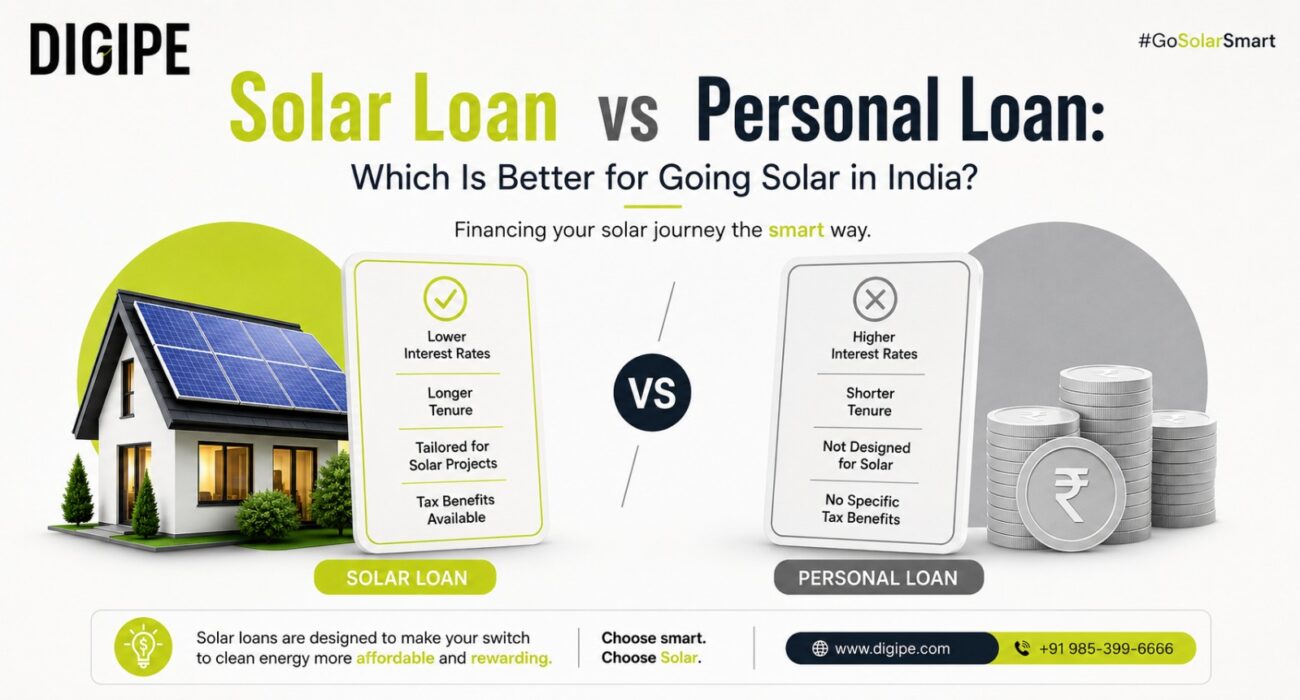
While both options can help you arrange funds, they are designed for very different purposes. A dedicated solar loan is specifically structured around renewable energy investments, whereas a personal loan offers flexibility but may come with different costs and repayment considerations.
This guide explains the difference between Solar Loan vs Personal Loan, helping homeowners, businesses, and industries in India make an informed financing decision.
Quick Answer: Solar Loan vs Personal Loan
For most people planning a solar installation, a solar loan is generally the better option because it is specifically designed for financing solar projects.
A personal loan, however, may be useful when you need funds quickly, want complete flexibility in how the money is used, or do not have access to a specialised solar financing product.
In simple terms:
- Choose a Solar Loan if you want financing specifically for a rooftop solar or commercial solar project.
- Choose a Personal Loan if flexibility and faster access to funds are more important than specialised solar financing.
The right choice ultimately depends on your project size, repayment capacity, eligibility, and the financing options available to you.
What is a Solar Loan?
A Solar Loan is a financing solution designed specifically to help individuals, businesses, and organisations install solar energy systems.
The funds can typically be used for expenses related to a solar project, such as:
- Rooftop solar panels
- Solar inverters
- Mounting structures
- Installation costs
- Electrical components
- Solar batteries, where applicable
- Engineering and project-related expenses
A solar loan allows customers to spread the cost of a solar installation over a structured repayment period instead of paying the entire amount upfront.
For many customers, this makes solar financing a practical way to start saving on electricity bills without waiting years to accumulate the complete project cost.
What is a Personal Loan?
A Personal Loan is generally an unsecured loan that can be used for multiple personal financial needs.
Unlike a dedicated solar loan, the lender may not require the borrower to use the money specifically for a solar project.
People commonly use personal loans for:
- Home improvements
- Education expenses
- Medical emergencies
- Travel
- Major purchases
- Debt consolidation
- Renewable energy installations
If you take a personal loan for solar installation, you receive the funds and use them to pay for your solar system.
While this flexibility can be useful, it is important to compare the overall loan cost, repayment tenure, and monthly EMI before making a decision.
Solar Loan vs Personal Loan: Key Differences
| Feature | Solar Loan | Personal Loan |
|---|---|---|
| Purpose | Specifically designed for solar projects | Can be used for almost any purpose |
| Solar-specific financing | Yes | No |
| Flexibility of usage | Limited to the approved solar project | High |
| Suitable for | Homeowners, businesses and industries | Individuals needing flexible funds |
| Project documentation | May require solar project details | Usually focused primarily on borrower eligibility |
| Large solar projects | Often more suitable | May be less practical depending on loan limits |
| Commercial applications | Available through specialised financing | Usually not ideal for business-scale projects |
| Solar project expertise | Financing may be structured around solar assets | General-purpose financing |
| EMI repayment | Structured based on the solar loan terms | Based on personal loan terms |
Note: Interest rates, tenure, eligibility, processing charges, and other terms vary depending on the lender and borrower profile. Always compare the complete financing offer before making a decision.
Why a Solar Loan Can Be Better for Going Solar
1. Designed Specifically for Solar Projects
The biggest advantage of a solar loan is that it is created for renewable energy investments.
The financing process may be better aligned with the actual requirements of a solar installation.
For example, the loan may consider:
- Project cost
- System capacity
- Installation requirements
- Expected energy savings
- Business or industrial energy consumption
This makes dedicated solar financing particularly useful for customers who are making a planned investment in renewable energy.
2. Helps Preserve Your Working Capital
Instead of paying the complete solar project cost upfront, financing allows you to preserve cash for other important requirements.
This can be particularly valuable for:
- Small businesses
- Manufacturing companies
- Commercial establishments
- Industrial facilities
A business can continue using its available capital for operations while financing the solar project through an appropriate solar project finance solution.
3. Solar Savings Can Support the Investment
One of the biggest attractions of solar energy is the potential reduction in electricity expenses.
When a properly designed solar system starts generating electricity, the savings on energy costs can improve the overall economics of the investment.
For businesses and industries with significant electricity consumption, this can make commercial solar financing an attractive option.
The goal is not simply to purchase solar panels. The goal is to invest in an energy solution that can potentially reduce long-term operating costs.
4. Suitable for Larger Projects
A personal loan may work for a relatively small residential solar installation.
However, larger projects may require more specialised funding.
Examples include:
- Commercial rooftop solar systems
- Industrial solar installations
- Large rooftop projects
- Multi-location solar projects
For these requirements, a dedicated solar loan for businesses or solar loan for industries may be more suitable than relying on general personal borrowing.
When Can a Personal Loan Be a Better Choice?
Despite the advantages of solar-specific financing, a personal loan can still make sense in certain situations.
1. You Need Flexible Funding
A personal loan provides flexibility.
For example, you may need funds for both:
- Solar installation
- Roof repairs
- Electrical upgrades
- Other home improvements
A personal loan can potentially provide one financing source for multiple expenses.
2. You Need Funds Quickly
Depending on the lender and your eligibility, personal loans can sometimes have a relatively straightforward application process.
If your solar installation is time-sensitive and you have access to a suitable personal loan offer, it may be worth comparing with available solar financing options.
3. Your Solar Project Is Small
For a smaller residential installation, the effort involved in arranging specialised solar installation financing may not always be necessary.
In such cases, comparing the available solar panel EMI with a personal loan EMI can help determine which option is more affordable.
Solar Loan vs Personal Loan: Which Is More Affordable?
This question does not have one universal answer.
The affordability of a loan depends on several factors:
Interest Rate
Compare the interest rate offered for both financing options.
Loan Tenure
A longer repayment tenure may reduce your monthly EMI but could increase the total interest paid over the life of the loan.
Processing Fees
Some loans include processing charges and other applicable fees.
Prepayment Charges
If you plan to repay the loan early using future savings, check whether prepayment charges apply.
Down Payment
Some solar financing arrangements may require the customer to contribute a portion of the project cost.
Total Cost of Borrowing
Do not compare loans based only on EMI.
A lower EMI does not always mean a cheaper loan.
Always compare:
Total Loan Amount + Interest + Fees + Other Applicable Charges
Solar Panel EMI: What Should You Consider?
The idea of paying for solar through a monthly EMI makes solar adoption more accessible for many customers.
However, before choosing a solar panel EMI, consider the following:
Can Your Monthly Budget Handle the EMI?
Your loan repayment should comfortably fit within your monthly financial capacity.
How Much Will You Save on Electricity?
Estimate your expected electricity savings after solar installation.
What Is the Loan Tenure?
A longer tenure reduces the monthly EMI but may increase the total cost of financing.
Is the Solar System Properly Sized?
An incorrectly sized system may not deliver the expected financial benefits.
This is why financing decisions should be connected to a proper solar project assessment.
Solar Loan for Rooftop Solar: A Smart Option for Homeowners
Residential rooftop solar is becoming increasingly popular across India.
Homeowners often face one major challenge: the upfront installation cost.
A solar loan for rooftop solar can help spread this investment over manageable monthly payments.
Before applying, homeowners should understand:
- Total system cost
- Expected electricity generation
- Roof suitability
- Available subsidies or incentives, where applicable
- Estimated savings
- Loan repayment terms
A good financing decision starts with understanding the complete economics of the solar system—not just the initial installation price.
Solar Loan for Businesses: Financing the Transition to Clean Energy
Businesses often consume significant amounts of electricity.
For commercial establishments, solar can potentially help reduce operating expenses over the long term.
However, paying the entire project cost upfront may affect working capital.
This is where a solar loan for businesses or specialised commercial solar financing solution can become valuable.
Businesses should evaluate:
- Current electricity expenses
- Annual energy consumption
- Available rooftop area
- Project cost
- Expected generation
- Financing cost
- Estimated savings
The best financing solution should support the business’s financial goals while making the solar project commercially viable.
Solar Loan for Industries: Managing Large Energy Requirements
Industrial facilities usually have much larger energy requirements than residential customers.
A manufacturing plant or industrial facility may require substantial investment to install an appropriately sized solar system.
For such projects, solar project finance can be more appropriate than a standard personal loan.
A specialised solar project loan India solution may consider the broader requirements of the project and business.
Industrial customers should carefully evaluate:
- Project size
- Energy consumption patterns
- Electricity tariff
- Expected solar generation
- Cash flow impact
- Financing structure
- Return on investment
For larger projects, choosing the right financing partner can be just as important as choosing the right solar technology.
How to Choose Between a Solar Loan and a Personal Loan
Use these questions to guide your decision.
Choose a Solar Loan If:
- You are financing a dedicated solar project.
- You need funding for a larger installation.
- You are installing commercial or industrial solar.
- You want financing designed around renewable energy projects.
- You are looking for structured solar project finance.
Choose a Personal Loan If:
- You need flexible use of the funds.
- Your solar project is relatively small.
- You want to combine solar expenses with other personal expenses.
- You have access to a competitive personal loan offer.
- You prefer a simpler general-purpose borrowing option.
Important Factors to Compare Before Taking Any Loan
Before selecting a solar finance provider or personal loan, compare these factors carefully.
1. Interest Rate
Understand whether the rate is fixed or variable and how it affects your repayment.
2. Loan Tenure
Choose a tenure that balances manageable EMIs with the overall cost of borrowing.
3. Processing Charges
Check all applicable fees before signing the agreement.
4. Prepayment Terms
Find out whether you can repay the loan early and whether charges apply.
5. EMI Amount
Ensure the monthly payment comfortably fits your budget.
6. Eligibility Requirements
Different lenders may have different eligibility criteria for individuals, businesses, and industries.
7. Customer Support
A financing partner should clearly explain the terms and conditions.
How to Find the Best Solar Finance Company
There is no single best solar finance company for every customer.
The right financing partner depends on your specific requirements.
When comparing options, look for:
- Experience in renewable energy financing
- Transparent loan terms
- Competitive financing structures
- Flexible repayment options
- Experience with residential or commercial projects
- Clear documentation
- Responsive customer support
Instead of selecting a provider based only on the advertised interest rate, evaluate the complete financing experience.
The best option should match your project requirements and financial capacity.
Solar Loan vs Personal Loan: A Simple Example
Imagine a homeowner planning a rooftop solar installation.
They have two options:
Option A: Personal Loan
The homeowner takes a general-purpose personal loan and uses the funds to pay for the solar system.
Advantages:
- Flexible usage
- Potentially quick access to funds
- No solar-specific process
Considerations:
- The loan is not designed specifically for the solar project.
- The overall borrowing cost should be carefully compared.
Option B: Solar Loan
The homeowner chooses specialised solar financing.
Advantages:
- Designed for solar installation
- May be structured specifically around the project
- Better suited for renewable energy financing requirements
Considerations:
- Documentation may include project-related information.
- Terms vary between financing providers.
The right decision depends on which option offers the best combination of affordability, flexibility, and suitability.
Frequently Asked Questions About Solar Loans and Personal Loans
1. Is a solar loan better than a personal loan?
For a dedicated solar installation, a solar loan is often the more suitable option because it is specifically designed for solar financing. However, a personal loan may be suitable when flexibility is the priority.
2. Can I take a personal loan for solar panels?
Yes, a personal loan can generally be used for various expenses, including solar installation, subject to the lender’s terms and conditions.
3. What is a solar panel EMI?
A solar panel EMI is the monthly repayment amount paid when a solar installation is financed through a loan or EMI-based financing arrangement.
4. Can businesses get a solar loan in India?
Yes, financing options may be available for businesses looking to install commercial solar systems. The eligibility and financing structure depend on the lender and project requirements.
5. Is solar financing available for industries?
Yes, industries may access specialised solar project finance or commercial financing solutions depending on project size, business profile, and lender eligibility.
6. What should I compare before choosing solar financing?
Compare interest rates, loan tenure, EMI, processing fees, prepayment terms, eligibility requirements, and the total cost of borrowing.
7. Is a solar loan available for rooftop solar?
Yes, financing solutions may be available specifically for residential and commercial rooftop solar installations.
8. How do I choose the best solar finance company?
Compare transparency, financing terms, experience, repayment flexibility, customer service, and suitability for your specific solar project.
9. Can solar savings help offset loan payments?
Solar energy can potentially reduce electricity expenses. Depending on the system’s performance, electricity tariffs, financing costs, and other factors, these savings can improve the overall economics of the investment.
10. Which is better for commercial solar financing?
For larger commercial projects, specialised solar financing or solar project finance is generally worth considering because it is designed around the specific requirements of the project.
Final Verdict:
Solar Loan vs Personal Loan—Which Should You Choose?
Both financing options can help you make the switch to solar energy.
However, for most dedicated solar projects, a Solar Loan is generally the more suitable choice because it is specifically designed for financing renewable energy investments.
A Personal Loan can be a useful alternative when flexibility, speed, or general-purpose funding is more important.
Before making a decision, compare more than just the EMI.
Look at the complete picture:
- Total financing cost
- Loan tenure
- Interest and charges
- Expected electricity savings
- Project size
- Your financial capacity
Going solar is a long-term investment. Choosing the right solar financing solution can make that investment easier to manage while helping you move towards lower electricity costs and cleaner energy.
Whether you are a homeowner looking for a solar loan for rooftop solar, a company exploring commercial solar financing, or an industrial organisation planning a large-scale solar project, the right financing strategy can play a major role in making your solar journey successful.